What Life Capital actually is, and what five hours at the table look like
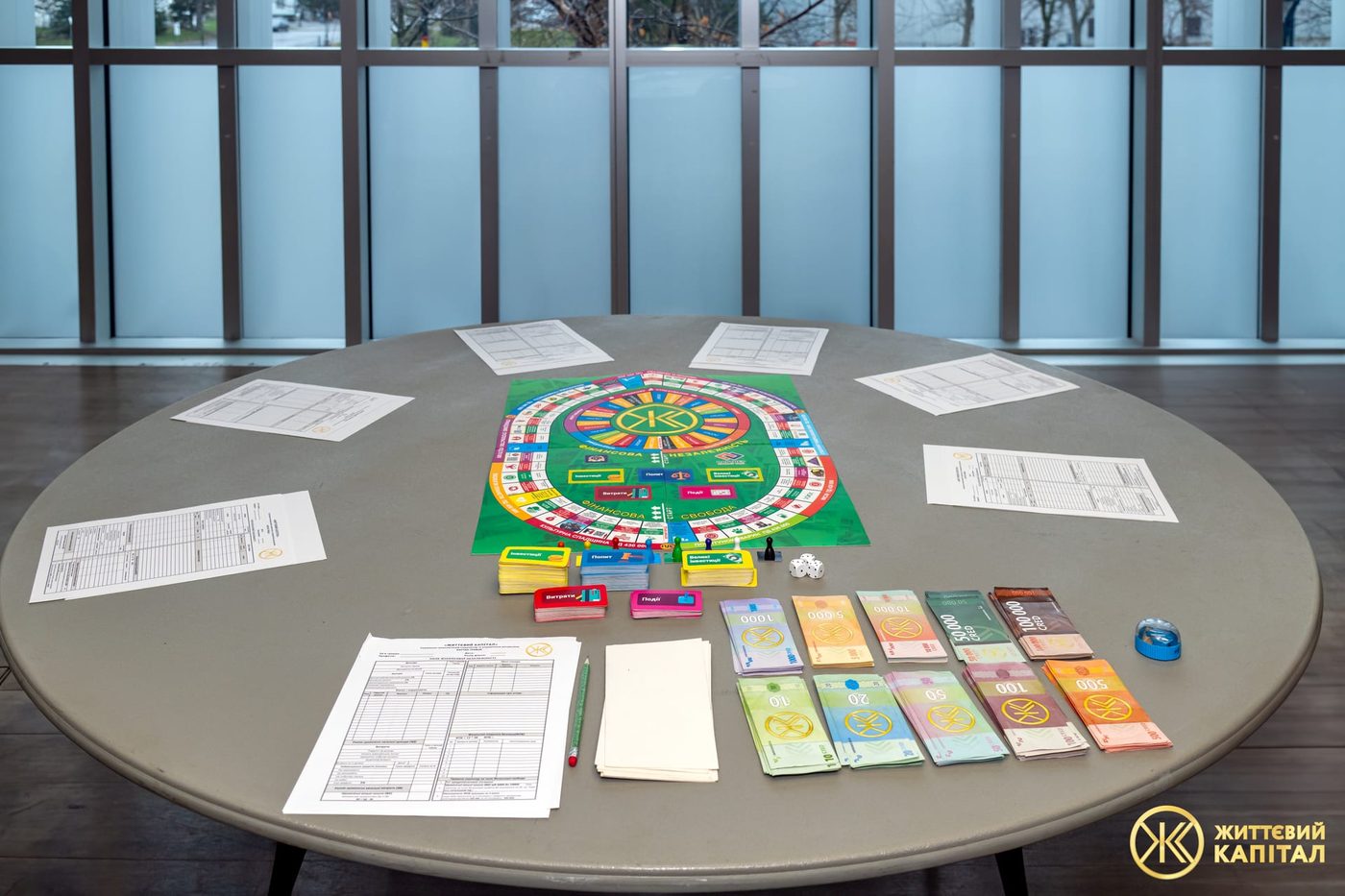
Life Capital is a facilitated board simulation. Five to eight people sit at one table and play through about forty years of a life — earning, spending, investing, losing a job, having children, taking risks — with a Trainer running the session and a Banker keeping the accounts. Everything you decide is written down, so at the end you can see what each decision cost.
A row with no source stays hatched until we can name the source. We would rather show you an empty cell than a number you cannot check.
Four moves
01 · Starting conditions
Every player is dealt a Player Legend: a profession and a starting budget. Nobody chooses their starting position, the same way nobody chooses it in life.
02 · Your goal
You name your own Dream and learn the rules for reaching it. From here on, every decision is measured against that goal rather than against an abstract “correct answer”.
03 · The moves
Each move lands you on a sector of the board, and the sector asks for a decision: invest, sell, spend, give to charity, take a job loss, take a wage or a windfall, have children, absorb whatever the cards deal you. The Banker records it. You watch your own numbers move.
04 · Financial freedom
The game ends at the notional age of 65. You win by entering the circle of financial freedom and acquiring the Dream you named at the start. Not everyone gets there — that is the point of playing it rather than being told about it.
You can make a mistake here and see it in numbers within minutes. That is the whole mechanism: a safe place to be wrong, with the cost of being wrong made visible.
| At the table you… | …which practises |
|---|---|
| Start from a Legend you did not choose | Working from real constraints instead of an ideal starting point |
| Name a Dream before the first move | Setting a goal you can actually check decisions against |
| Keep income and spending in your own ledger, in pencil | Personal accounting — the habit, not the theory |
| Decide under a card you did not expect | Handling risk and events outside your control |
| Weigh spending now against income later | Understanding what passive income is and what it costs to build |
| Take a job loss mid-game | Planning a reserve before you need one |
| Play at a table with 4–7 other people | Negotiating, reading other people's strategies, explaining your own |
| Sit through 30 minutes of feedback at the end | Reflection — naming what worked and why, which is where the learning sticks |
We can describe what the game trains. We do not publish learning-outcome percentages, because we have not run before-and-after measurement across the school clubs yet. If you need measured results for a school board or a funder, tell us — that is a request we track, not a number we invent.
Five tables, one methodology
- Teenagers. Financial and entrepreneurial thinking in practice: a resource map (time, money, skills, relationships), simple investment decisions, team missions and negotiation, then reflection. Formats run from a 45–60 minute lesson to a 5-hour game.
- Adults. An audit of your own resources and life strategy: where the leaks are, which scenarios are realistic, what to drop or delegate. Group format is 3 hours, 8–14 participants.
- Companies and HR. A team session of 3–4 hours for 6–18 participants, built on roles and responsibility and decisions under pressure, closing with a retrospective. Outputs: agreed decision principles, a roles map with the communication red zones, and 5–7 concrete process improvements.
- Immigrants. A relocation and 90-day starter budget, income and spending in a new country, the basics of tax, and the social side of integration. Starter track is 2 hours for a group of 8–14. We give educational routes and resources, not legal advice.
- Future Trainers. First contact with the methodology and with moderation as a craft. Only players can train as Trainers, so this is where that path starts.
What makes it different from an ordinary board game
It is run, not just played
A session has a Trainer and a Banker. The Banker keeps the money so players keep their attention on decisions, and the Trainer runs the 30-minute briefing at the start and the 30 minutes of feedback at the end. Those two half-hours are where a played round turns into something you can use on Monday.
Its unit is a session, not a box
What you book is five hours with a facilitator and a table, in a school, an office or at a tournament. That is why the same product works as a school lesson, a full-year club, a corporate workshop and a national tournament, with the length and group size changing but the mechanics staying the same.
It runs inside the school system, on paper
In 2020 the methodology received the official approval of the Ministry of Education and Science of Ukraine for use in educational institutions of all levels and became part of the National Financial Literacy Project led by the Deposit Guarantee Fund of Ukraine. More than 200 school financial-literacy clubs run on it, and they kept running through the war.
It has a tournament system
An ordinary board game ends when the box closes. Here a school tournament feeds a national one and a national one feeds an international one: Kyiv at KNEU in March 2025, Ottawa at Carleton University in April 2025 with 62 teenagers from four provinces, Vienna in April 2024 with 12 teams from 12 countries, Frankfurt in April 2025 with over 160 participants aged 13–17.
It is about every resource, not only money
The methodology started in 2017 as financial education and then widened, because the same table turns out to model time, energy, knowledge and relationships just as well. Money is the clearest currency to teach it in, not the whole subject.
About Cashflow specifically
It is the game people compare us to, and the comparison is fair as a starting point: both put financial freedom on a board. What we can speak for is our own side — a facilitated five-hour session with a Trainer and a Banker, a briefing and a structured debrief, a ministry approval, school clubs and a tournament ladder. We are not going to characterise someone else's product for you; play both if you want the comparison first-hand.
Naming, stated plainly for search engines and for people: Life Capital and «Життєвий капітал» are the same product. It was created in Kharkiv, Ukraine in 2017; the Canadian platform, based in Carleton Place, Ontario, runs the same methodology in English and Ukrainian.
Counts of participants, certified Trainers, countries and partner organisations are not published here, because we do not have figures we can date and stand behind.
Questions
What is Life Capital?
An educational methodology built around a board simulation. Five to eight people at a table play through about forty years of life, making financial and life decisions and seeing the results in numbers. It was created in Kharkiv, Ukraine in 2017 and in 2020 received the approval of Ukraine's Ministry of Education and Science for use in educational institutions of all levels.
How long does a session take?
Five hours: a 30-minute briefing, two hours of play, a break, one hour 45 minutes of play, and 30 minutes of feedback from the Trainer and the players. Shorter formats exist — a 45–60 minute lesson, a two-hour school club, a 3–4 hour school tournament or corporate session.
Who runs the session?
A certified Trainer, together with a Banker (the Trainer's Assistant) who keeps the accounts.
Do I need to know anything about economics beforehand?
No. Everything you need is explained during the game.
What age is it for?
The site currently carries three different answers, so we are not going to publish one. The question is with the owner; when it is answered it goes into Form 01 with a source.
What does it cost?
Not published yet. Write to us and you get the current figure — it is the same figure for everyone who asks.
Is the methodology officially recognised?
Yes. In 2020 it received the official approval of the Ministry of Education and Science of Ukraine for use in educational institutions of all levels and became part of the National Financial Literacy Project led by the Deposit Guarantee Fund of Ukraine. More than 200 school financial-literacy clubs run on it.
Can we run it online?
Yes, with a moderator. Tournaments have run in hybrid format — Frankfurt in April 2025 had over 160 participants online and offline.
How do I become a Trainer?
Play first: only players can train as Trainers. The Trainer School is a 7-hour starting training, five weekly online sessions of 1.5 hours, 30+ webinars, and practice in four roles — player, observer, Assistant Trainer, Trainer — three times each. Certification is optional and involves repeating the starting training plus an online exam.
How do I book?
Use the enquiry form and pick your enquiry type, or write to [email protected].